Artificial intelligence (AI) is no longer just a futuristic idea. It has become an important part of how businesses market their products and services online. From creating content and analyzing customer behavior to improving advertisements and automating repetitive tasks, AI is changing digital marketing faster than ever.
In 2026, businesses that understand how to use AI effectively can save time, make smarter decisions, and create more personalized experiences for their customers. However, AI is not replacing marketers completely. Instead, it is becoming a powerful tool that helps marketing teams work faster and focus more on strategy and creativity.
Let’s explore the major ways AI is changing digital marketing in 2026.
- AI Is Transforming Content Creation
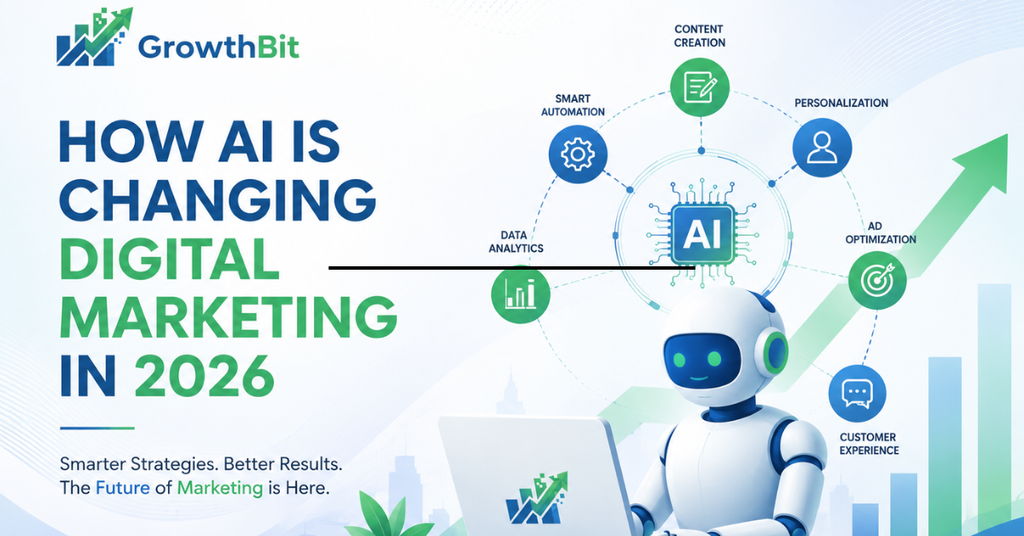
Content marketing has always required significant time and effort. Marketers need to research topics, create outlines, write content, design visuals, and keep their content relevant.
AI tools can now assist with many of these tasks. Marketers can use AI to brainstorm blog topics, create content outlines, generate social media ideas, summarize information, and improve existing drafts.
However, simply publishing AI-generated content isn’t enough. Businesses still need to review facts, add original insights, and make their content useful for real people.
The best approach in 2026 is AI-assisted content creation, where AI helps with efficiency while humans provide experience, creativity, opinions, and brand personality.
- AI Is Changing SEO
Search engine optimization is also being influenced by AI. Search engines are becoming better at understanding the meaning behind searches instead of simply matching keywords.
AI can help marketers with keyword research, search-intent analysis, content planning, competitor research, and identifying potential content gaps.
At the same time, AI-powered search experiences are changing how people discover information online. This means businesses need to focus on creating content that is accurate, useful, well-structured, and genuinely valuable.
Traditional SEO is still important, but marketers increasingly need to think about visibility across both traditional search and AI-powered search experiences.
- Personalized Marketing Is Becoming Smarter
Customers don’t want to see irrelevant advertisements or generic messages. They expect brands to understand their interests and needs.
AI can analyze large amounts of customer data and help businesses identify patterns in user behavior. This allows marketers to create more personalized campaigns.
For example, an e-commerce business can use customer behavior to recommend relevant products. An email marketing campaign can also be personalized based on a customer’s previous interactions.
This type of personalization can make marketing messages more relevant and improve the overall customer experience.
- AI Is Improving Paid Advertising
Paid advertising platforms are increasingly using AI and machine learning to help advertisers optimize their campaigns.
AI can assist with audience targeting, bidding, ad placement, campaign optimization, and performance analysis. Instead of manually adjusting every element of a campaign, marketers can use automated systems to identify opportunities and make adjustments based on performance data.
However, marketers still need to define the right goals, audiences, budgets, and creative direction. AI can optimize a campaign, but it still needs a good strategy behind it.
- Social Media Marketing Is Becoming More Efficient
Managing social media can be time-consuming, especially for small businesses. AI can help marketers generate content ideas, create captions, analyze performance, and identify trends.
AI can also help businesses understand which types of content perform well with their audience.
For example, a marketer could use AI to analyze previous posts and identify common patterns in engagement. These insights can then be used to develop future content.
The goal isn’t to let AI run your entire social media presence. Instead, it should help marketers spend less time on repetitive tasks and more time creating meaningful content.
- AI Is Making Marketing Analytics More Powerful
Marketing generates a huge amount of data. Website visits, clicks, conversions, social media engagement, email opens, and advertising performance can all provide valuable information.
The challenge is understanding what that data actually means.
AI can help identify patterns and trends that might be difficult to spot manually. It can help marketers understand which campaigns are performing well, where customers are dropping off, and which areas may need improvement.
This allows businesses to make decisions based more on data and less on guesswork.
- Marketing Automation Is Becoming More Advanced
Automation has been part of digital marketing for years, but AI is making it more intelligent.
Businesses can automate tasks such as email workflows, customer segmentation, lead qualification, reporting, and routine communication.
AI-powered automation can also respond to changing customer behavior. For example, customers can receive different messages depending on their interactions with a website or previous marketing campaigns.
This can save marketing teams considerable time while creating a smoother customer journey.
- AI Is Changing Customer Support
Customers increasingly expect quick answers to their questions. AI-powered chatbots and virtual assistants can help businesses provide support around the clock.
They can answer common questions, provide basic information, guide customers through simple processes, and direct more complicated requests to human team members.
The key is finding the right balance. AI can handle routine questions efficiently, while humans can step in when customers need empathy, detailed assistance, or complex problem-solving.
- AI Is Helping Marketers Understand Competitors
Competitive research can take a lot of time. Marketers need to monitor competitors’ websites, content, advertisements, social media activity, and overall positioning.
AI can assist by organizing large amounts of information and helping marketers identify patterns and opportunities.
For example, AI can help identify frequently discussed topics within an industry, potential content gaps, and areas where a business could differentiate itself.
This gives marketers more information to build stronger strategies.
- Human Creativity Still Matters
With all these changes, one important thing hasn’t changed: marketing still needs people.
AI can generate ideas, analyze information, and automate tasks, but it doesn’t replace human understanding completely.
Brand personality, storytelling, creativity, emotional connection, strategic thinking, and genuine customer understanding remain extremely important.
The businesses that succeed in 2026 won’t necessarily be the ones using the most AI tools. They will be the ones that know where AI can help and where human expertise matters most.
The Future of AI and Digital Marketing
AI is becoming a core part of digital marketing, and its influence will continue to grow. From SEO and content marketing to paid advertising, analytics, personalization, and automation, AI is helping businesses work more efficiently and make better decisions.
For businesses, the goal shouldn’t be to replace their marketing team with AI. Instead, AI should be viewed as a tool that helps people work smarter.
At GrowthBit, we believe the future of digital marketing belongs to businesses that combine technology with creativity, strategy, and a genuine understanding of their customers.
AI can provide the tools. The right strategy turns those tools into results.
Conclusion
AI is changing digital marketing in 2026 by making marketing faster, more personalized, data-driven, and automated. Businesses can use AI to improve content creation, SEO, advertising, social media, analytics, customer support, and many other areas.
But AI alone isn’t a marketing strategy.
The strongest approach is to combine AI’s speed and analytical capabilities with human creativity, experience, and strategic thinking. Businesses that learn to make this combination work can build stronger digital marketing strategies and stay competitive in an increasingly digital world.